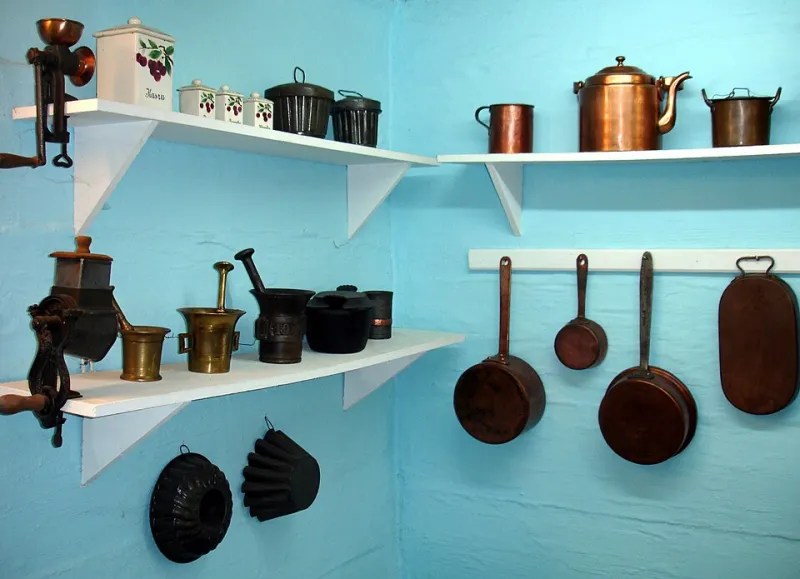
Five Dead Giveaways That Your 'Handmade' Copper Isn't
Photo: Angry Red Hammer Guy, CC BY-SA 4.0, via Wikimedia Commons
Let's be blunt about something the marketplace would rather we weren't: a lot of what's sold as "handcrafted copper" these days has never been within ten feet of a human hand. It's stamped, spun, and finished by machines in a matter of minutes, then photographed in moody light next to a wooden spoon and a linen towel.
Is a machine-made pot the end of the world? No. But if you're paying artisan prices, you deserve artisan work — and the good news is that handwork leaves fingerprints everywhere. You just have to know where to look.
1. The Hammer Dimples Tell the Truth
Real planishing — the hand-hammering that strengthens and textures copper — produces dimples that are close but never identical. Look closely: the spacing drifts slightly, the depth varies, and rows overlap in organic ways. Machine-hammered "texture" is metronome-perfect, with identical dimples repeating like wallpaper. Perfection is the tell. Humans can't do it, and that's the whole point.
2. Look at the Seams, Not the Shine
A hand-raised vessel is often formed from a single disc of metal, which means no seam at all — or, where joins exist, a hand-fitted, soldered and hammered-flat seam that's been worked until it nearly disappears. Mass production relies on visible machine crimps, rolled beads, or glue-line joints. Run your thumb along the underside of a rim or base. If it feels like a folded aluminum baking pan, it was made like one.
3. The Lining Has to Be Thick Enough to Matter
Quality copper cookware is lined with tin (or, less traditionally, stainless) to keep food safe, since bare copper reacts with acidic ingredients. Here's the catch: a proper hand-applied tin lining is a serious, visible layer — slightly uneven, with that lovely mottled "tinnie" look. Cheap imports electroplate a whisper-thin coating that wears through in a year. If the lining looks factory-flawless and paper-thin, it is.
4. Weight and Ring
Pick the piece up. Handcrafted copper is thick — usually 1.5mm to 2.5mm or more on cookware — and it feels substantial, almost ceremonial. Tap the side with a knuckle. Thick, well-worked copper rings with a warm, bell-like note. Thin stamped stock answers with a hollow, tinny rattle. Your ears are a better quality-control department than any label.
5. The Underside Never Lies
Flippers and resellers know buyers check the top, so that's where the finishing effort goes. Flip the piece over. Handmade work shows an honest, finished base — a maker's mark, hand-scribed or stamped, clean joinery, maybe faint traces of the stakes and forms the metal was shaped over. A laser-etched "handmade" logo on a machine-spun base is the trade's favorite magic trick.
Why Any of This Matters
Beyond honesty in labeling, these details track directly with performance. Thick, hand-worked copper spreads heat with remarkable evenness. Proper linings last decades and can be retinned, not replaced. Good seams don't split. A handcrafted piece is repairable, resalable, and inheritable — the machine version is destined for the donation bin the first time it warps.
And honestly, there's the aesthetic side, too. Those slightly irregular hammer marks catch kitchen light in a way no stamped texture ever will. That's not a flaw in the finish. It's the record of a person at a bench, doing the work the slow way.
When you shop, shop like a skeptic. Ask who made it, where, and how. If the answers are vague, look harder at the dimples. The metal always talks.