The Pot That Refuses to Quit: What Heirloom Copperware Can Teach Us About Craft
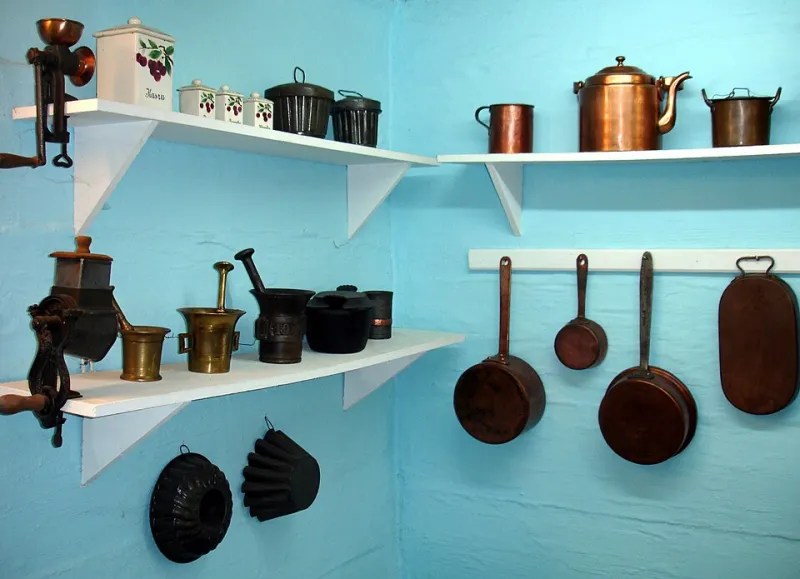
Photo: Silar, CC BY-SA 4.0, via Wikimedia Commons
Somewhere in an American kitchen right now — maybe yours, maybe your mother's — there's a copper pot that has outlived three microwave ovens, two dishwashers, and every nonstick pan bought since 1995. It's dented. It's tarnished. It has probably made ten thousand batches of fudge or Sunday gravy. And here's the thing: it's still better than most of what you can buy new today.
I've spent my working life hammering copper, and pieces like that are the reason I do it. Let's talk about why they last, and what to do if one lands in your hands.
Copper Doesn't Really Wear Out — It Just Gets Character
The physics hasn't changed since your grandmother bought her pots. Copper conducts heat roughly five times better than cast iron and around twenty times better than stainless steel. That's not marketing copy; that's why serious candy makers and jam preservers never gave it up. A copper pan responds to a dial turn almost instantly — no lag, no hot spots scorching one side of your sauce.
But conductivity is only half the story. The other half is construction. Heirloom pieces were typically raised from a single sheet of copper, hammered by hand or on simple presses, with handles riveted on — not welded, not glued. When a pot is one continuous piece of metal with no seams to fail, there's remarkably little that can go wrong. Modern mass-produced cookware, by contrast, is often a sandwich of bonded layers. When those layers separate (and they do), the pan is done.
A well-made copper pot from the 1940s is essentially a piece of metal that got shaped into a pot. With basic care, there's no reason it won't outlast your grandchildren.
The Three Things That Actually Fail — And Why They're All Fixable
When people bring vintage copper into the shop, the problems are almost always the same three:
1. Worn tin lining. Most lined copper cookware wears through the tin eventually, exposing copper. That's not dangerous — cooking acidic foods like tomatoes in bare copper long-term isn't ideal, but the fix is simple. A coppersmith can retin the piece, a day's work that costs far less than a premium new pan.
2. Loose handles. Rivets loosen after decades of use. A quick re-riveting — often with solid copper or brass rivets better than the originals — brings the handle back to rock solid.
3. Tarnish and grime. This one isn't even a repair. A paste of white vinegar and salt, or a commercial polish like Bar Keepers Friend, strips away decades of dullness in an afternoon. Underneath, the metal is fine.
That's the whole list. Compare that to a modern nonstick pan, which is landfill-bound the moment the coating scratches.
Restoring an Inherited Piece: The Weekend Version
If you've just come into a copper pot or kettle, here's how to bring it back without doing harm:
- Skip the dishwasher. Always. Harsh detergents accelerate tarnish and can pit the metal. Hand wash, dry immediately.
- Polish with what's in your pantry. Vinegar and salt, or half a lemon dipped in salt, will lift tarnish. Work in circles, rinse well, dry thoroughly.
- Don't scrub the interior to mirror shine. If the piece is tin-lined, polish the exterior copper only. The dull gray inside is the tin doing its job.
- Check the rivets. Wiggle the handle gently. A little movement is normal; a lot means it's time for a professional.
- Leave the dents alone. Small dents are history, and hammering them out risks thinning the copper. A coppersmith can planish a piece properly if it bothers you.
When to Call a Coppersmith Instead of Replacing
Honestly? Almost always. Retinning runs roughly $30–60 per piece at most American shops, and re-riveting is similar. A quality new copper pan, meanwhile, starts around $200 and climbs fast. The math isn't close.
Call a professional if the tin lining is peeling or flaking, if a handle moves under gentle pressure, if there's a crack or split in the body, or if the piece is a family heirloom you'd rather not experiment on. Most coppersmiths will assess it for free or cheap and tell you straight whether it's worth saving.
What I tell customers: your grandmother didn't buy that pot as an investment. She bought it because it was the best pot she could afford, made by someone who expected it to be used hard for fifty years. It was. It can be used hard for fifty more. Very few things made today can say the same — and that's the standard I try to hit at my own bench every single day.