From Utah Ore to My Bench: Following One Pound of Copper Across the Country
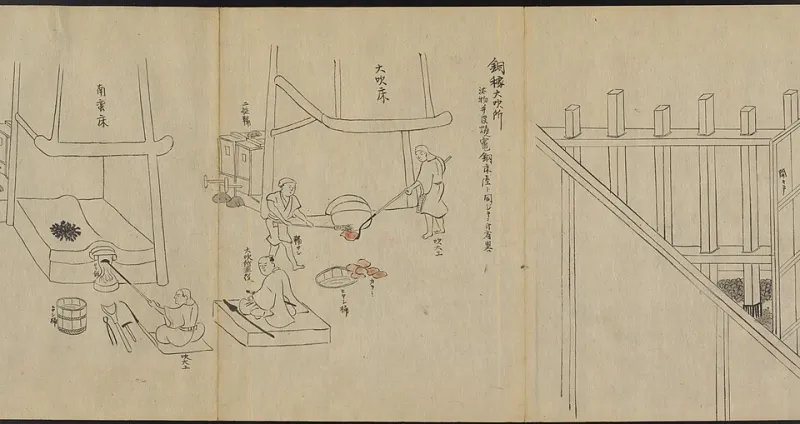
Photo: , Public domain, via Wikimedia Commons
Every morning when I light the torch, I'm holding the end of a very long story. Most customers never think about where the metal in a copper pot begins, and honestly, I didn't either when I started. Then one slow winter I got curious and started making calls. What I found surprised me: the supply chain behind American-made copperware isn't some sprawling, anonymous network. It's a handful of mines, a couple of smelters, a few distributors, and shops like mine — and nearly everybody in it knows the others by name.
Where It Starts: A Hole in Arizona
The vast majority of American copper comes out of enormous open-pit mines — places like the Bingham Canyon Mine outside Salt Lake City, which is so big astronauts can reportedly spot it from orbit, and the sprawling operations scattered across southern Arizona. These aren't romantic places. They're industrial, dusty, loud, and absolutely essential.
I spoke with an engineer at one Arizona operation who put it plainly: "We move about as much rock in a day as a small mountain range." The ore that comes out is mostly waste — less than one percent of it is actual copper. That fraction gets concentrated on-site into a powder called concentrate, which is about as glamorous as it sounds: a gray-green dust that looks like nothing at all.
But that dust is the beginning of every pot, still, and downspout I've ever made.
The Smelter: Where Rock Becomes Metal
Concentrate doesn't do anybody any good until it's smelted, and there are only a couple of places in the United States that still do it at scale. The famous one is in Miami, Arizona — a smelter that's been running in some form for over a century. Inside, furnaces hit temperatures north of 2,300 degrees Fahrenheit, hot enough to pull pure copper away from the sulfur and iron it's bonded to.
The output is called anode copper — plates about 99 percent pure. From there, most of it goes to an electrolytic refinery, where the plates are suspended in an acid bath and zapped with electricity until they're 99.99 percent pure cathode copper. Fun fact I learned on my tour: the sludge that settles at the bottom of those refining tanks contains gold and silver, which helps keep the whole operation profitable.
By the time copper leaves the refinery, it's been through more transformation than most materials ever see. And yet — here's the part that gets me — it's still just metal. The character hasn't been added yet. That happens later, and it happens by hand.
The Middlemen Nobody Thinks About
Here's where the chain gets interesting for a small shop like mine. Refineries don't sell to artisan coppersmiths. They sell to mills and service centers — companies that take cathode copper and turn it into the sheet, rod, and plate that shops actually order. Some of the sheet I buy is rolled in the Midwest; some comes through distributors who warehouse it in places like Cleveland and Houston.
The woman who manages my account at a metal service center in Ohio knows my order by heart: 16-ounce and 20-ounce sheet, dead soft, annealed. When I asked her once how many independent coppersmiths she supplies, she laughed. "You're all on one spreadsheet," she said. "I could fit the whole American craft copper trade in a conference room."
That stuck with me. The entire domestic ecosystem of people making traditional copperware by hand — maybe a few hundred shops nationwide — depends on a supply chain that's only a few links long, held together by people who answer their own phones.
The Last Link: The Bench
When my sheet copper arrives, the journey isn't over — it's really just starting. The mill's metal is soft and blank and honest, but it doesn't become anything until somebody raises it, hammers it, anneals it, and hammers it again. Every dishing and planishing pass adds structure the mill could never give it. That's the part of the story I get to write.
There's something humbling about being the last stop on a line that runs from a hole in the Arizona desert through a furnace in Miami and a rolling mill in Ohio. My work is a small percentage of what that copper becomes — most of it goes to wiring, plumbing, and electronics — but the craft trade is the part where the metal gets a face put on it, literally the mark of a hammer.
Can This Ecosystem Survive?
I'd be lying if I said I wasn't worried. Imported machine-spun copperware floods the market at prices I can't touch, and some of it is fine work. But the domestic chain I've described — miner to smelter to mill to bench — is thin in places. Smelters are expensive to run under modern environmental rules, and every closure makes the chain longer and more fragile.
Still, I'm cautiously hopeful. Demand for American-made goods keeps growing, and the craft shops are stubborn by nature. The same people who kept traditional copperwork alive through the worst decades of the last century didn't do it because it was easy. They did it because somebody has to be the last link in the chain.
Next time you pick up a handcrafted copper pot, trace that line backward in your head: a mine, a furnace, a rolling mill, a delivery truck, a bench. It's a short supply chain, but every link in it is a person. I've met most of them. They're worth knowing.