Fifty-Year Cookware: How to Care For, Fix, and Rescue Your Copper
Photo: Shixart1985, CC BY 2.0, via Wikimedia Commons
Every so often somebody shows up at my booth holding a pot the way you'd hold a wounded bird. Dented, dark, tin worn through to orange metal at the bottom. "Is it dead?" they ask. Almost never. In twenty-some years at the bench, I can count on one hand the pieces I've told people to let go of. Copper doesn't really die. It just needs somebody willing to work with it a little.
We've gotten used to the opposite arrangement. Nonstick pans are basically disposable — three to five years and into the landfill. Copper is the antidote to that. A well-made piece can outlive you, your kids, and probably your grandkids' kitchen remodel. But longevity is a two-way street. Here's what you actually need to know.
First, Decide What Look You're After
Before any maintenance talk, settle one question: shiny or aged? Neither is wrong.
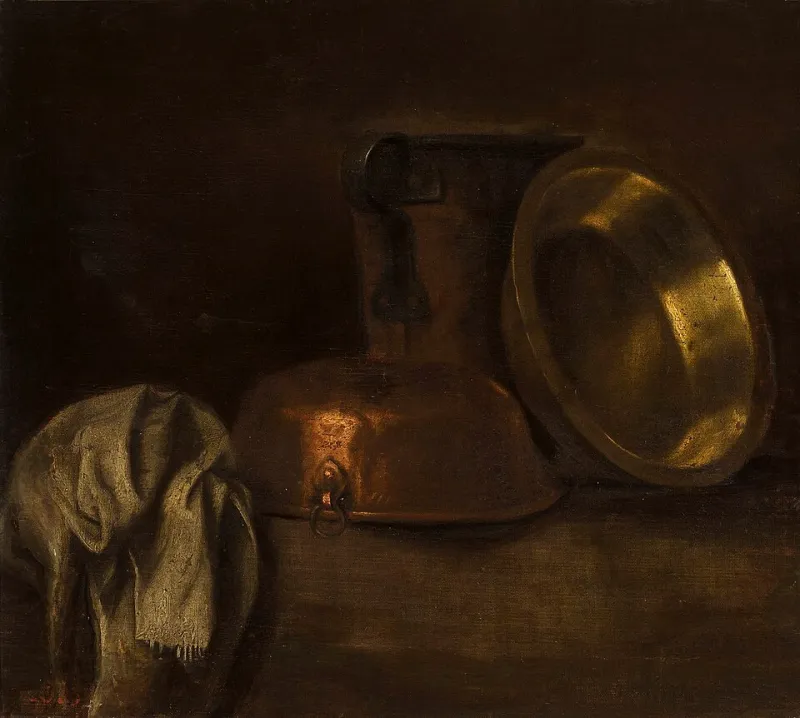
If you want the bright, penny-gleam look from the showroom, you'll polish. If you're like me and most working cooks, you'll let the pot earn its patina — that deep, mottled brown-to-turquoise character that tells everyone this piece has made a lot of Sunday gravy.
Polishing, if you do it: a commercial copper cleaner (Bar Keepers Friend works fine), a soft cloth, gentle circular motions, and a thorough rinse and dry. Never use steel wool or anything abrasive on tin lining. Once a month is plenty; more than that and you're just wearing the metal away for vanity.
If you're team patina: wash with dish soap, dry it immediately, and stop worrying. The darkening is not damage. It's a resume.
The Seasonal Checklist
Pin this to the fridge:
- After every use: Hand wash, dry completely. Copper hates sitting wet.
- Monthly: Inspect the lining. Shiny silver-pink is tin; if you see orange or salmon showing through, keep reading.
- Twice a year: Check rivets and handles for wobble. Tighten gently or plan a visit to a metalsmith.
- Annually: Deep-clean the exterior (polish or not), and check for dents that make the pot sit unevenly on the burner.
- Never: Put it in the dishwasher. Just don't. The detergents strip tin and wreck finishes.
Retinning: The Big One
The tin lining inside a copper pan is a sacrificial layer. It melts at a low temperature and wears down over years of use — that's by design. It protects your food from contacting raw copper (which reacts with acidic foods like tomatoes and wine) and it's meant to be renewed.
When you see orange metal peeking through in patches bigger than a quarter, or a scratch line across the cooking surface, it's retinning time. This is not a DIY job — it involves molten tin at 450°F and real skill to get an even coat. A good retinner (several shops around the country still do this by hand, including folks I trade work with) will strip, clean, and re-tin a pan for somewhere in the range of $30–75 depending on size. For a quality piece, that's cheap insurance on a fifty-year timeline.
A pan with worn tin but intact copper is like a car with worn tires. The car's fine. Fix the tires.
Dents, Rivets, and Other Small Surgeries
Small dents are mostly cosmetic. If one bothers you, a wooden mallet and a sandbag (or a folded towel on a hard surface) will let you coax it out with patient, light taps from the inside. Work slow. Copper is forgiving but not infinitely so.
Loose rivets are more serious because a wobbly handle is how pots get dropped. Some rivets can be peened back tight with a ball-peen hammer and a backing block — but if you're not confident, this is exactly the kind of fix a maker is happy to do. Which brings me to:
When to Ship It Back — and When to Let Go
Send a piece to the maker (or a restoration shop) when:
- The handle is loose or cracked
- The lining needs retinning
- There's a crack, not just a dent — cracks in copper are structural
- It's an heirloom with sentimental value worth doing right
Call it a goner only when the copper itself is cracked through, corroded thin from decades of neglect, or the piece was cheaply made to begin with. Even then, a broken pot can live on as a planter, a wall piece, or a kitchen island sculpture. Copper rarely leaves the family entirely.
The Long View
Here's the thing nobody says out loud in the cookware aisle: the ability to repair something is the whole point of owning it. A retinned pan is a small act of rebellion against the throwaway economy. Every piece that comes through my shop for a new lining has already outlived a dozen nonstick pans, and it'll outlive a dozen more.
Care for it like you plan to hand it down — because if you do it right, you will.