The Muse on the Mantel: How Copper Became Art's Favorite Supporting Actor
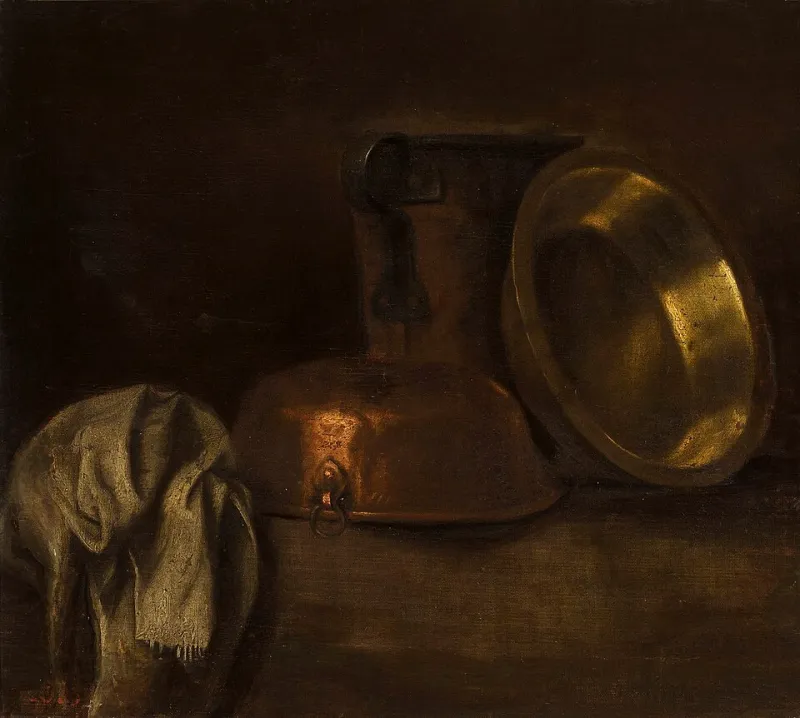
Photo: Martin Dichtl, Public domain, via Wikimedia Commons
Walk through the still-life wing of just about any major American museum — the Met, the National Gallery, the Art Institute of Chicago — and you'll start noticing a pattern. Before you spot the pheasants, the split figs, or the half-peeled lemon, you'll spot the pot. A dented copper kettle slouched in the corner. A measure cup catching a sliver of window light. Four hundred years of painting, and artists keep reaching for the same prop.
There's a reason for that, and it's not just tradition. As a guy who spends his days raising and hammering this stuff, I'd argue copper earned its place in the frame the same way it earns a place in your kitchen: by being the most cooperative, most characterful material a maker or an artist can work with.
Why the Dutch Couldn't Stop Painting It
Start with the Dutch Golden Age. Seventeenth-century painters like Pieter Claesz and Willem Kalf built whole careers on tables groaning with food, and almost always, somewhere in the composition, sat a copper vessel. Sometimes polished bright, sometimes dulled with use.
The choice was deliberate. Still life in that era wasn't just decoration — it was a conversation about abundance, mortality, and the value of made things. Copper did triple duty. Its warm, ruddy tone played beautifully against cool blues and deep greens. Its reflective surface let a painter show off, bouncing the light of an unseen window across a curved belly. And because every household owned some, viewers read it as a symbol of domestic competence — a well-run home.
A dented, well-used pot was the seventeenth-century equivalent of a cast-iron skillet with a story. It said someone here cooks. Someone here works.
The American Take, and the Photographer's Secret
American still-life painters in the 1800s — the Peales, Severin Roesen with his overflowing fruit compositions — inherited the habit. Then photography came along, and here's the part most people miss: the prop never left.
Flip through any serious food magazine or cookbook shot by a stylist worth their salt. Chances are good there's a copper pot, a copper measuring cup, or a copper mixing bowl somewhere in the frame. Food stylists know something the Dutch Masters knew: copper photographs warm. Literally. The metal reflects light in the red-orange end of the spectrum, which flatters everything near it — bread, butter, a pour of wine. Stainless steel reads clinical. Copper reads like dinner at your grandmother's.
There's also the patina question. A machine-stamped copper-look pot photographs flat, because it is flat — every surface identical, no history to catch the light. Handmade pieces have hammer marks, slight ripples in the metal, a solder line here and there. Those imperfections break up reflections into a hundred tiny highlights. On camera, that texture reads as depth. As life. It's the difference between a photograph of an object and a photograph of a home.
Styling Your Own Copper for the Camera
You don't need a museum wing to get in on this. A phone and a window will do. A few things I've learned shooting my own work over the years:
- Let it be used. A pot with tomato-sauce shadows and honest wear photographs better than one buffed to a mirror. If you want shine, shine it the morning of the shoot — patina rebuilds in a week anyway.
- Kill the overhead lights. One window, camera between the window and the subject. Copper's reflections need a single, believable light source, same as in a Vermeer.
- Pair it with rough against smooth. Copper next to linen, raw wood, or a cut lemon makes the metal's glow pop. Copper next to granite countertops just looks lonely.
- Fill it with something. Empty pots are inventory. Filled pots are a story — tomatoes, flowers, wooden spoons standing at attention.
- Shoot the edge, not the front. A slight angle shows the profile of the hammered rim, which is where handmade work actually announces itself.
What the Frame Is Really Saying
Here's the through-line from a 1640s Amsterdam studio to a 2020s food blog: copper signals that a human made this and a human uses this. Painters used it to whisper about abundance and the good life. Photographers use it because it makes food look edible. Collectors like you keep it on the open shelf for the same reason — it's the rare object that improves the room it's in even when it's doing nothing at all.
So the next time you're at the museum and you catch yourself staring past the dead game and bruised pears at that battered pot in the corner, give it a nod. It's been holding the composition together for four centuries. It'll be holding yours together at dinner tonight, too.