Coal Smoke and Coffee: Twelve Hours at the Copper Bench
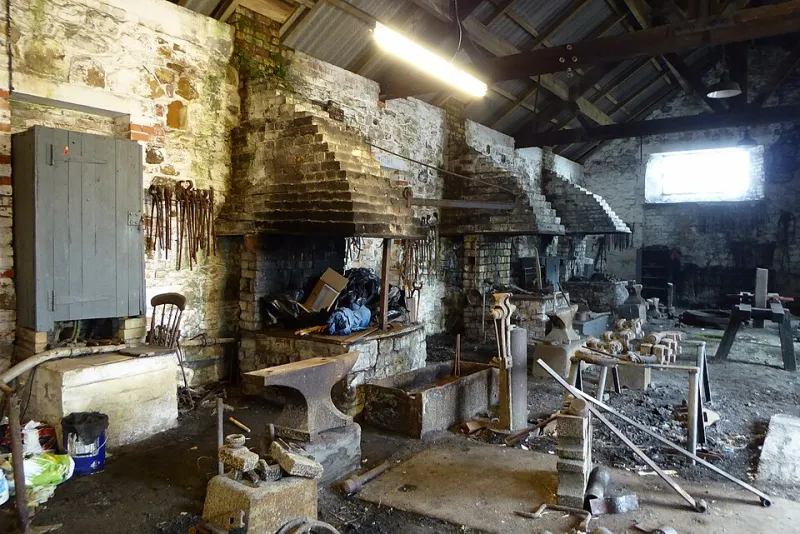
Photo: John Lord from Edinburgh, Scotland, CC BY 2.0, via Wikimedia Commons
The alarm goes off at 4:45. I don't need it anymore — my hands know what time it is — but I set it anyway, because a shop run on feel alone eventually runs on chaos.
By 5:15 I'm pulling into the gravel lot outside my shop here in western North Carolina. The mountains are still blue-black silhouettes. The coffee is still hot. Both facts are temporary, so I savor them.
5:30 AM — Lighting the Fire
The forge is the first thing I touch every morning, before lights, before email, before anything. There's a reason for that. If the fire isn't right, nothing else I do all day matters.
I rake yesterday's clinker out, layer fresh coal around the firepot, and get the airflow going. Coal fires have moods. Too much air and you get a roar that'll burn your copper before you can say "oops." Too little and the fire sulks. What you're hunting for is a clean, bright center with a quiet shell of coke around it — the kind of heat that moves metal like it's got opinions of its own.
While the fire builds, I drink my coffee on the anvil stump and look at the day's order list. Three candle holders, a pair of mixing bowls, one large stock pot for a customer in Ohio who's been waiting patiently since September. Sorry, Diane. Today's your day.
7:00 AM — The Disc Becomes a Dish
A copper pot starts life as a flat disc. That's the part people find hardest to believe when they visit the shop. This thing in my hands right now is exactly as flat as a manhole cover. By lunch, it'll be a bowl.
Forming is a conversation, not a fight. You anneal the copper — heat it to a dull cherry red and quench it — because copper work-hardens. Every hammer blow makes it stiffer and crankier. Heat it back up and it forgives you, goes soft again, lets you keep bending it toward the shape in your head.
Anneal, form, anneal, form. Over and over. I've stopped counting the cycles on a big pot somewhere around the point where my forearms stop having opinions.
By 9:30 the stock pot blank has a deep, even wall and Diane's pot officially exists. It's ugly right now — lumpy, hammer-marked, honest. That comes later.
10:30 AM — Planishing: The Boring Part That Is Everything
If forming is the conversation, planishing is the apology. Hundreds of thousands of light hammer taps, each one landing on steel stakes, each one smoothing and tightening the surface. It's the difference between a pot that dents when you look at it wrong and one your grandkids will argue over.
I won't pretend this part is romantic. It's the same motion for three hours. My podcast queue earns its keep here. But there's a rhythm to it, and somewhere around the second hour the rhythm takes over and I stop hearing the hammer at all. Old-timers called it getting in the swing. I've never heard a better term.
1:30 PM — Solder and Seams
Lunch is a sandwich at the bench, because stopping now would mean losing the heat of the day. The seams on the candle holders need soldering, and solder waits for no mood.
A good solder joint is invisible. If you can see it, it's a bad joint wearing makeup. I flux the seam, feed the solder along the heat line, and let capillary action do the work — the metal pulls the solder where it wants to go, and your only job is to not get in the way.
The rivets on the pot handles go in next. Every rivet gets peened by hand, one at a time. Riveted handles are one of those old details that got engineered out of modern cookware because it's slow. It's slow because it's better.
4:00 PM — Filing, Sanding, Grudge-Holding
Every shop has a least favorite job. Mine is filing. It's tedious, it's exacting, and it punishes impatience. I file every edge, every seam, every spot where a sharp corner might catch a thumb twenty years from now. Because somebody's thumb matters. Maybe not today, but someday a kid will run her finger along the rim of this pot and I'd rather she remember it fondly.
6:30 PM — The Polish
By the time the light through the shop windows has gone amber, the day's pieces are ready for finishing. The polishing wheel throws that particular warm glow off the copper that made me fall in love with this metal in the first place — the color of a penny held up to a sunset.
Diane's pot comes off the wheel looking like it was poured, not hammered. I stamp my maker's mark on the underside, wrap it in cloth, and set it by the door with the shipping label already printed. Sorry for the wait, Diane. I think it was worth it.
8:00 PM — Bank the Fire, Lock the Door
The last thing I do is the first thing I did: tend the fire. I bank the coals for tomorrow, close the damper, and stand there a second in the fading warmth.
People ask why my pots cost what they cost. Twelve hours on one pot, that's part of the answer. But the real answer is this: every piece that leaves this shop carries a full day of somebody's hands. Fire, hammer, solder, polish. The old way. There's no shortcut that doesn't leave a mark.
Tomorrow the fire gets lit again at 5:30. There's a set of measuring cups waiting.