Who Picks Up the Hammer After Us? Inside the Quiet Crisis of the Copper Apprentice
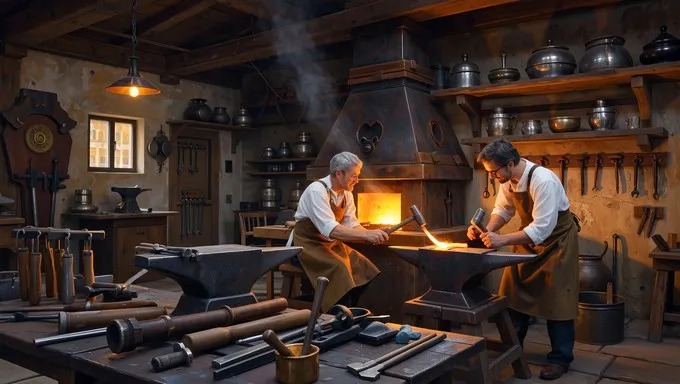
Photo: blacksmith apprentice workshop hammering metal young craftsman, via images.stockcake.com
Last spring, a high school kid wandered into my shop during a street fair, watched me raise a bowl for about four minutes, and asked the question I've come to dread: "How long before you can do that?"
"About ten thousand hours," I told him.
He laughed. Then he realized I wasn't joking, and his face did something I see a lot of lately — a polite sort of sympathy, like I'd told him I walk to work in another state.
That interaction is the whole problem in miniature. Not just for my shop, but for every working metalsmith in America under the age of about sixty-five. The craft isn't dying because nobody wants copper pots. Demand for handmade copperware has never been better. It's dying because almost nobody can afford to learn it.
The Math That Doesn't Work
Let's start with the uncomfortable arithmetic. A traditional apprenticeship runs five to seven years. During most of that time, an apprentice produces a fraction of what a journeyman produces, which means they cost the shop money instead of making it. In the old guild model, that loss was an investment. Today, a small shop like mine has to eat that cost directly.
I ran the numbers once. Training a single apprentice to the point where they're net-positive on the bench costs me roughly what a part-time employee's salary would — except I'm also paying for material they'll ruin, annealing gas they'll waste, and the slow, patient correction of mistakes I made myself thirty years ago.
I spoke with Dana Whitfield, who teaches metalworking at a community college in the Midwest, and she put it bluntly: "The shops that could take apprentices are the shops that can least afford the downtime. The big production shops can afford it, but they've engineered the craft out of the work. There's no traditional apprenticeship to run."
And from the apprentice's side? Seven years of modest wages versus seven years of, say, HVAC certification or electrical work — trades with shorter runways, union pipelines, and starting pay that doesn't require a trust fund to accept. I love this work with my whole heart. I'd be lying if I told a twenty-two-year-old it's the rational choice.
The Instant-Gratification Problem
Then there's the cultural piece, and I want to be careful here, because the easy version of this argument — "kids these days" — is both lazy and wrong.
Young people aren't allergic to hard work. Look at the boom in small-scale farming, in boutique woodworking, in people restoring barns on YouTube. What they are allergic to is a decade of invisibility with no clear payoff. Social media has compressed everyone's sense of progress. You can learn to sourdough in a weekend, to weld in a certificate program, to code in a boot camp. Metalsmithing offers no such shortcut, and the honest ones among us shouldn't pretend otherwise.
The first two years of hammering copper are mostly making ugly things and learning why they're ugly. That's a hard sell in a culture where the apprenticeship is expected to be content, too — where a slow week at the bench feels like a failure because nobody posted about it.
What's Actually Working
Here's the hopeful part, and it's not hypothetical. A handful of shops around the country are quietly rebuilding the model.
Some are shortening the runway. Instead of a seven-year commitment, they're offering structured two-year residencies — enough time to learn the fundamentals, with a clear path to either stay on or leave with real skills. It's not the old guild system, but it respects the reality of modern life.
Some are getting paid. A few nonprofit craft schools — the kind with week-long and month-long intensive courses — have become the de facto on-ramp. Students pay for the training up front, then approach established shops with a foundation already in place. It inverts the old economics: the apprentice invests in themselves instead of the master investing in the apprentice. Not ideal, but it's moving people through.
And some are just being honest. The most effective recruitment tool I've seen isn't a program at all — it's a shop that tells the truth. When I show a prospective apprentice the ugly first-year bowls I still keep in a box under my bench, something changes in the room. They understand the deal. Nobody's selling them a montage.
Can the Craft Survive Another Generation?
I don't know. I'd be doing you a disservice if I pretended to.
What I know is this: every generation of craftsmen has been told the craft is dying. My own mentor heard it in the seventies, when cheap imported cookware nearly killed the American coppersmithing trade outright. He survived by being too stubborn to quit and too good to ignore.
Maybe that's the answer, as unsatisfying as it is. The craft survives the way it always has — one shop, one apprentice, one stubborn old soul willing to eat the cost of teaching. Not because it pencils out, but because somebody has to hold the hammer until the next pair of hands is ready.
If you're young and reading this and something in your chest leaned forward: come find us. The bench is patient. It'll wait for you.
It's the only thing about this trade that is.